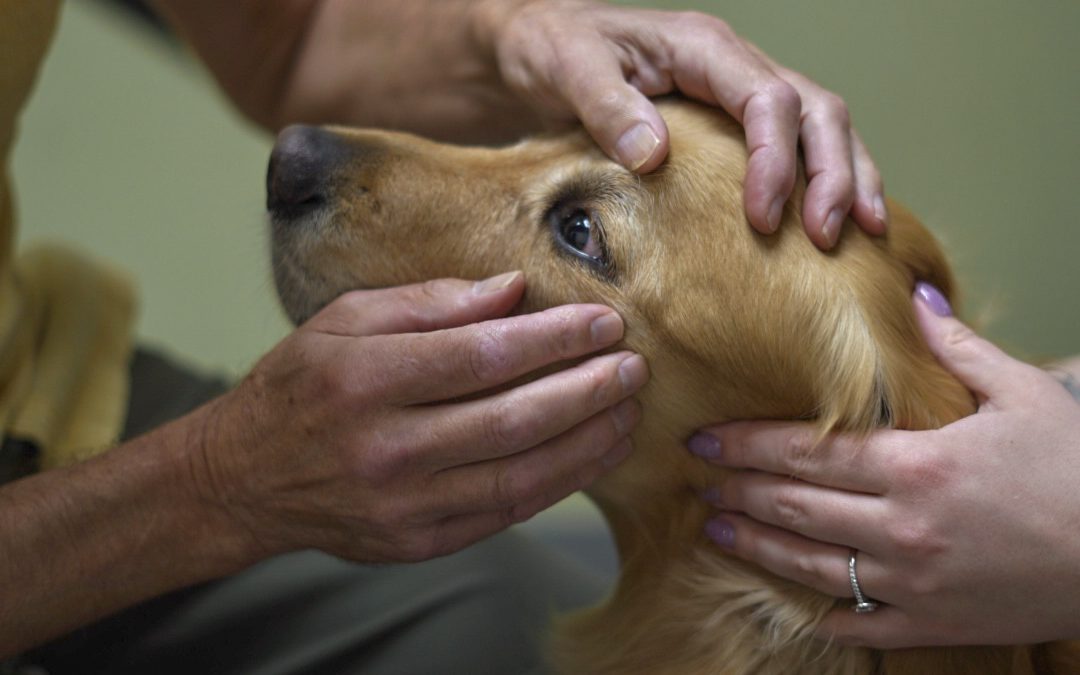
If you’ve been following Archie for a while, you probably already know him well. So when something wasn’t quite right with his eyes, I wanted to share what happened—not because I want anyone to panic, but because I learned something I think other dog owners, especially Golden Retriever owners, should know.
The first thing I noticed was simply redness in the whites of Archie’s eyes.
That was it.
He wasn’t acting dramatically different. There wasn’t anything that immediately made me think we were dealing with a serious eye problem. His veterinarian wasn’t overly concerned at first either, and allergies were a possibility.
But the redness didn’t go away.
And that little detail—something that seemed so easy to dismiss—eventually led us to a veterinary ophthalmologist, where we learned that there was much more going on inside Archie’s eyes than I could see from the outside.
Archie was diagnosed with pigmentary uveitis, a condition that Golden Retriever owners should be aware of.
I’m sharing our experience because, if I’m being completely honest, I didn’t know what I was looking for either.
I knew his eyes were red.
I didn’t know that persistent redness could be a warning sign of inflammation inside the eye, or why getting that inflammation under control is so important.
Now we’re treating Archie’s eyes with prescribed drops twice a day, and we’re learning what this diagnosis means for him going forward.
So I thought I’d share what I’ve learned—not as a veterinarian, but as Archie’s person.
Because sometimes the things we need to pay attention to aren’t the dramatic symptoms.
Sometimes they’re the small things that just don’t go away.
Redness was Archie’s clue, but it isn’t necessarily the earliest or most distinctive sign of GRPU. Some early changes are visible only during a specialist’s exam.
So, What Exactly Is Pigmentary Uveitis?
When I first heard the words pigmentary uveitis, I’ll admit I had no idea what they meant.
Uveitis is inflammation inside the eye. In Golden Retrievers, there is a particular condition often referred to as Golden Retriever pigmentary uveitis (GRPU). It is associated with changes inside the eye, including inflammation and pigmentary changes, and it can lead to more serious problems such as cataracts and glaucoma.
And that is the part that really got my attention.
Because when I looked at Archie, all I could see was redness.
I couldn’t see the inflammation happening inside his eye.
That’s one of the reasons I’m sharing this. What looks like a simple red eye on the outside may be telling you that something much more significant is happening on the inside.
Why Golden Retrievers?
This isn’t something I ever had on my radar as a Golden Retriever owner.
But Golden Retrievers are one of the breeds in which certain uveal or iris changes are associated with chronic inflammation and can be associated with glaucoma and cataract formation.
Resource: How a veterinary ophthalmologist is addressing a disease that can affect golden retrievers
That doesn’t mean every Golden Retriever with a red eye has pigmentary uveitis. It doesn’t mean every Golden will develop it.
But I do think it means Golden owners should know that persistent changes in the eyes deserve attention.
And if your dog’s eyes don’t look right and the problem isn’t going away, it’s worth talking with your veterinarian about whether an eye specialist should take a look.
What Should You Look For?
Archie’s experience has definitely changed the way I look at his eyes.
Things I would pay attention to now include:
- Persistent redness in the whites of the eyes
- Squinting or holding an eye partly closed
- Excessive tearing
- Rubbing or pawing at the eyes
- Sensitivity to light
- Cloudiness or a change in the appearance of the eye
- A change in the size or shape of the pupil
- Anything that simply looks different from your dog’s normal eyes
Some dogs with eye disease don’t necessarily look dramatically sick. That’s what makes these things so easy to overlook.
In Archie’s case, the redness was the clue.
Why Treatment Is So Important
This is probably the biggest thing I want people to take away from Archie’s story.
Uveitis isn’t just a case of having irritated or red eyes.
Inflammation inside the eye can cause complications, including cataracts and secondary glaucoma. Chronic or recurrent inflammation can make these problems more difficult to manage.
Resource: Signs to watching for and why an eye exam matters
And glaucoma is particularly concerning because increased pressure inside the eye can damage the optic nerve and threaten vision. Early glaucoma can also have surprisingly subtle signs, which is why measuring the pressure inside the eye is such an important part of ophthalmic care.
Resource: Cataracts, glaucoma and monitoring eye pressure
So when we’re putting Archie’s drops in twice a day, we’re not just trying to make his eyes look less red.
We’re treating the inflammation and trying to protect his eyes for the future.
That’s a very different way of looking at it.
Our New Routine
For now, Archie has eye drops twice a day, as prescribed by his veterinary ophthalmologist.
I’ll admit that anytime you have to put medication into your dog’s eyes, it can feel a little intimidating at first.
But like everything else with our dogs, you find a routine.
Morning.
Drops.
Evening.
Drops.
And we keep going.
I’ll update this part of Archie’s story as we learn more about how he responds to treatment and what his ophthalmologist recommends for managing his condition long-term.
Because this isn’t necessarily a “treat it once and forget about it” situation. Chronic eye inflammation can require ongoing monitoring, and his ophthalmologist will be watching for changes and complications along the way.
What I Wish I Had Known
If I could go back to the beginning, I don’t think I would have known to immediately think, pigmentary uveitis.
That’s not realistic.
What I do wish I had known is this:
A red eye that doesn’t go away deserves another look.
Our veterinarians can only work with the information we have at the time. Allergies were a reasonable thought.